Property Rush
A Monopoly-style property-trading board game: buy cities, build houses, trade with rivals and collect rent.
See open tablesFree, in the browser. You get a short code to send your friends; guests play without an account. Every seat is a real person — there are no computer opponents.
Open Property Rush tables
Looking…Sit me at the fullest table.
We look for a Property Rush table that is nearly full and still open. Nothing open? We start one for you.
How Property Rush plays
Buy the city, charge the rent
Land on a city nobody owns and you may buy it. After that, everyone else who stops there pays you rent.
A whole country doubles the rent
Own every city in one country and their rent doubles before a single house goes up. The host can switch this off.
Decline and it goes to auction
Pass on a city and the table bids for it instead; it stays with the bank only if nobody bids. The host can switch this off.
Short of cash, you owe the rest
Rent you cannot cover takes what you have, and the rest follows as you mortgage, sell or trade. Below zero you cannot roll; you are out only if you declare bankruptcy or stop playing altogether.
Last one in, or the richest at the limit
With no round limit, the last player left in wins. If the host sets one, the richest in cash, cities and buildings wins when it runs out.
Nobody can stall the table
Turns are untimed, so you can take the decision you need to. A player who makes no move at all for two and a half minutes leaves the table.
Play Property Rush online, free
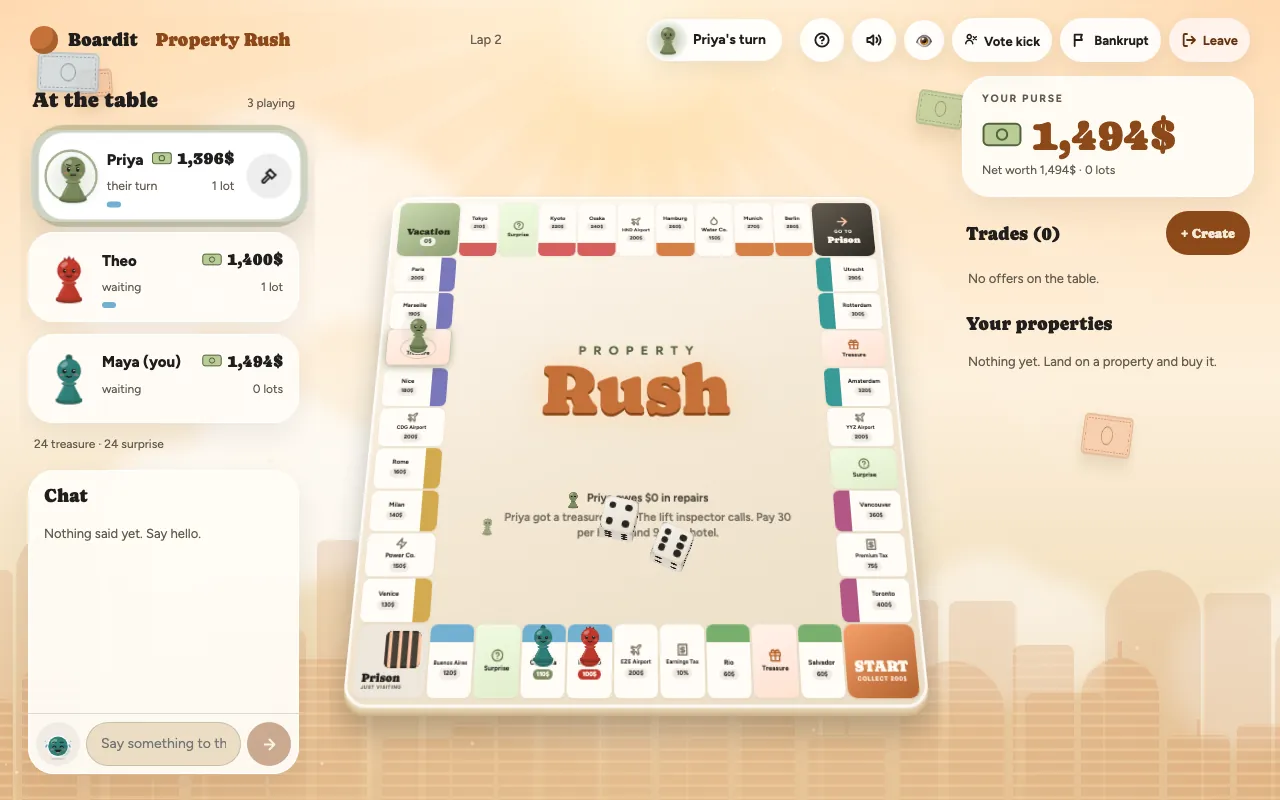
Property Rush is a property trading game for two to six players. You move around a world board buying cities — Rio, Rome, Osaka, Berlin, Toronto — collecting them by country, and charging everyone who lands on them until only one player still has money. The genre it belongs to goes back to Elizabeth Magie’s Landlord’s Game of 1904, designed to demonstrate how rent concentrates wealth — a lesson the games that followed kept intact while losing the politics. It is one of the longer games on Boardit, usually around 45 minutes, and the only one where the winner is generally decided a good while before the last player admits it.
Setting up
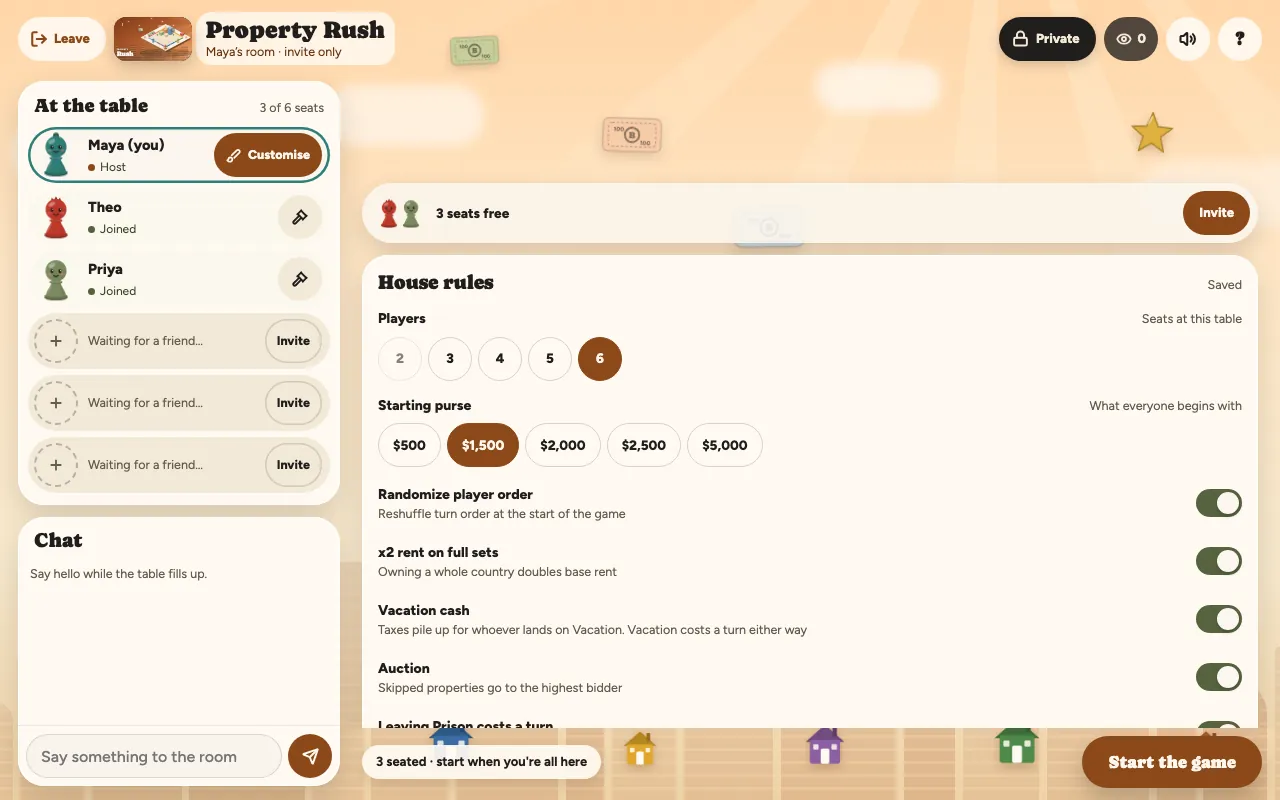
Everybody starts with the same cash and a piece at the beginning of the board. Nothing is owned. Seats are taken in the lobby and the host sets the rules for the table. Turn order is shuffled when the game starts, so the host does not automatically go first; a host who switches the shuffle off gets seat order instead. Two to six players; a fuller table contests the cities sooner, but also adds turns, auctions and possible trades. Three or four leaves more room for each player to build a position.
Taking a turn
Throw, move, and deal with the square you land on. An unowned city may be bought at its price. An owned one costs you rent to the player holding it. The decision that actually matters is whether to buy at all: money spent early is rent collected later, but money spent on a city whose country you never complete is money gone. Owning every city in one country doubles the rent across all of them, which is the mechanic the whole game turns on — scattered ownership produces a long, flat game, and one completed country produces a short and decisive one. Airports and taxes sit between the countries and are what stop a cheap opening lap from being free. Halfway round is the Vacation corner, which always costs whoever lands there their next turn; with the Vacation cash rule on, as it is by default, it also pays them the pot that taxes, Prison fines and other payments to the bank have built up.
How it ends
There is no round limit: the game plays out to the last player standing. A bill you cannot cover does not end your game on the spot: your cash goes below zero, and you cannot roll or end your turn until you have mortgaged, sold or traded your way back above it. A player who cannot raise the money is out, by declaring bankruptcy or by going quiet until the idle clock removes them, and their cities go back to the bank unowned. Turns themselves are untimed, so a game is as long as the table makes it; a group that wants a shorter evening can start with a smaller purse, which makes money tight sooner.
How to win at Property Rush
The whole economy turns on completing a country. A single city collects a small rent; the same city inside a finished set becomes much more valuable, so a property is worth more to the player holding the rest of its country than to anyone else. That asymmetry is what makes trading the real game. Auctions are the second lever: declining a property puts it in front of everybody at whatever the table will pay, and it stays with the bank only if nobody bids. Watch the bank, too. With the shortage rule on, thirty-two houses are shared by the table; holding houses can delay another player until hotel upgrades return stock to the bank. And keep a cushion — passing the start square pays two hundred, but rent does not wait for it, and mortgaging costs ten per cent to undo.
What the host can change
The host sets the table up in the lobby, and the rules freeze when the game starts. There is no round limit, so a game runs until one player is left or the players leave. The starting purse runs from $500 to $5,000, $1,500 by default. The rest are switches: auctions for declined cities, Vacation cash, mortgages, even building with a finite bank of houses, double rent on complete countries, no rent for owners in Prison, a lost turn for leaving Prison, and a shuffled turn order. All of them start switched on. The strategy on this page assumes those defaults; changing them changes which decisions matter.
Why Boardit plays it this way
The board uses 22 real cities in eight countries rather than invented streets, so a player can see at a glance that Paris and Marseille belong together. A city nobody buys goes to auction rather than staying in the bank, so declining is a decision about who gets it, not a way to skip it. Rent you cannot pay becomes a debt you work off by mortgaging, selling or trading, instead of knocking you out the moment a bad roll lands. There is no round limit: a game ends when one player is left or the players decide to stop, rather than being called by a counter. And turns have no countdown, because a trade or an auction deserves some thought; only a player who stops moving for two and a half minutes leaves, so the table can carry on.
Playing Property Rush online
Playing a property trading game online removes the two things that usually stop one happening: finding the box, and getting everybody into the same room. Property Rush is a browser game with no download — two to six players join a table with a five-character code from any device, and guests never make an account. Quick match will seat you at an open table instead, if you have nobody to invite. Multiplayer is live rather than turn-by-email: everybody watches the same board, so an auction is something the table participates in together and rent is charged in front of the person paying it. A typical game is about 45 minutes, but seats, auctions, trades and house rules all affect it. There is no countdown on a turn; a player who makes no move for two and a half minutes leaves the game so the table can go on.
Common questions
- Can you trade cities with other players?
- Yes. Players can offer each other cities, and a swap goes through only when both sides accept it. Because a city is worth most to whoever holds the rest of its country, trading is where most games are really decided: the offer that completes a country for both players is the one most likely to be accepted.
- Is Property Rush a property trading game?
- Yes. It is a property trading board game you play online with friends: you buy cities, collect rent, bid at auction when nobody buys, and trade cities with the other players to complete a country. It runs in the browser on each player's own phone or laptop, with no download and no account needed to join a table.
- How many players does Property Rush need?
- Two to six. Three or four is the sweet spot: enough competition for the countries to be contested, few enough that your next turn arrives before you have forgotten your plan. With two there is only one person to negotiate with and every blocked country is a direct contest.
- How long does a game of Property Rush take?
- Around 45 minutes, though seats, auctions, trades and house rules all move it. There is no round limit, so it ends when one player is left; a smaller starting purse makes for a quicker game. Turns themselves have no countdown.
- What happens if you do not want to buy a city?
- It goes to auction, and every player at the table can bid, including the one who declined; it stays with the bank only if nobody bids. That changes what passing means: it is not a way to save money quietly, it is a decision to let somebody else have the city at whatever the table will pay. The host can turn auctions off, in which case a declined city simply stays unowned.
- Why does completing a country matter so much?
- Owning every city in one country doubles the rent across all of them, and it is the only way to start building houses there. It is the difference between rents that are an annoyance and rents that end somebody’s game, and it is usually what decides the match.
- What is on the Property Rush board?
- The board holds 22 cities across eight countries — Brazil, Argentina, Italy, France, Japan, Germany, the Netherlands and Canada — running from Salvador and Rio at the cheap end up to Vancouver and Toronto at the top, with four airports, two utilities and two taxes in between. The four corners are Start, Prison, Vacation and Go to Prison; landing on Vacation costs your next turn and, by default, pays you the pot of taxes, fines and other payments to the bank collected since somebody last stopped there.
- What happens if you run out of money?
- You do not drop out on the spot. A bill you cannot cover takes your cash below zero, and until you are back above it you cannot roll or end your turn: you mortgage cities, which costs ten per cent to reverse later, sell houses back at half what they cost, or trade. If nothing raises enough, you are out and your cities go back to the bank unowned. Raising money on a country you have almost completed is usually the mistake that decides a game.
- Are there houses and hotels, and can they run out?
- Yes. With the shortage rule enabled, as it is by default, the bank holds thirty-two houses and twelve hotel tokens. Upgrading four houses to a hotel returns those houses to the shared supply, so a shortage can delay another player without permanently removing those houses from the game.
- Can I play Property Rush against the computer?
- No — every seat is a real person who joined with the room code or through Quick match; there are no computer opponents. You need at least one other player, on their own phone or laptop.