Ludo
Roll the die and race your four pieces home. Land on a rival to send them back to the start.
See open tablesFree, in the browser. You get a short code to send your friends; guests play without an account. Every seat is a real person — there are no computer opponents.
Open Ludo tables
Looking…Sit me at the fullest table.
We look for a Ludo table that is nearly full and still open. Nothing open? We start one for you.
How Ludo plays
A six to leave base
Nothing comes out of a corner until its colour throws a six.
A six, a capture or a piece home throws again
Any of them buys another go. Three sixes in a row loses the turn instead.
A pair protects itself
Two pieces of one colour on a square cannot be taken. Opponents may still pass over them.
Starred squares are safe
The eight marked squares — the four front doors and the four stars — take nobody.
The exact number comes home
The centre has to be reached exactly. An overshoot simply cannot move that piece.
All four pieces to win
The rest keep playing for second and third once someone is home.
30 seconds a turn
Run out and the table throws for you and plays an obvious move, so nobody stalls the board.
Play Ludo online with friends
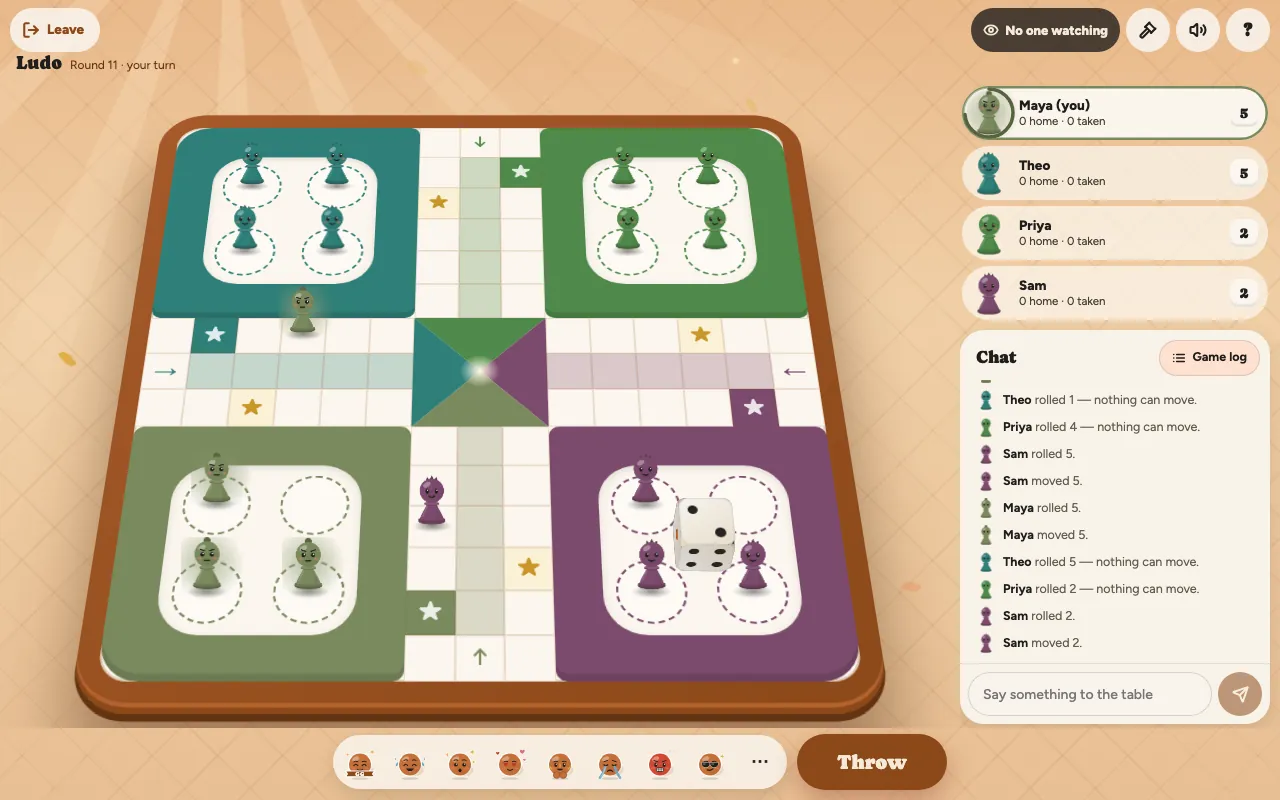
Ludo is a race game for two to four players, descended from the Indian game pachisi and played more or less unchanged across South Asia, the Middle East, Africa and Europe for a century. Each player takes a colour and four pieces, and the whole game is the journey those pieces make: out of the corner, once around the board, and up the home column into the centre. It takes about a minute to learn and considerably longer to stop arguing about, because the dice decide who moves and the players decide what to do about it. Nothing here is a variant invented for the web — these are the rules people actually play by.
Setting up
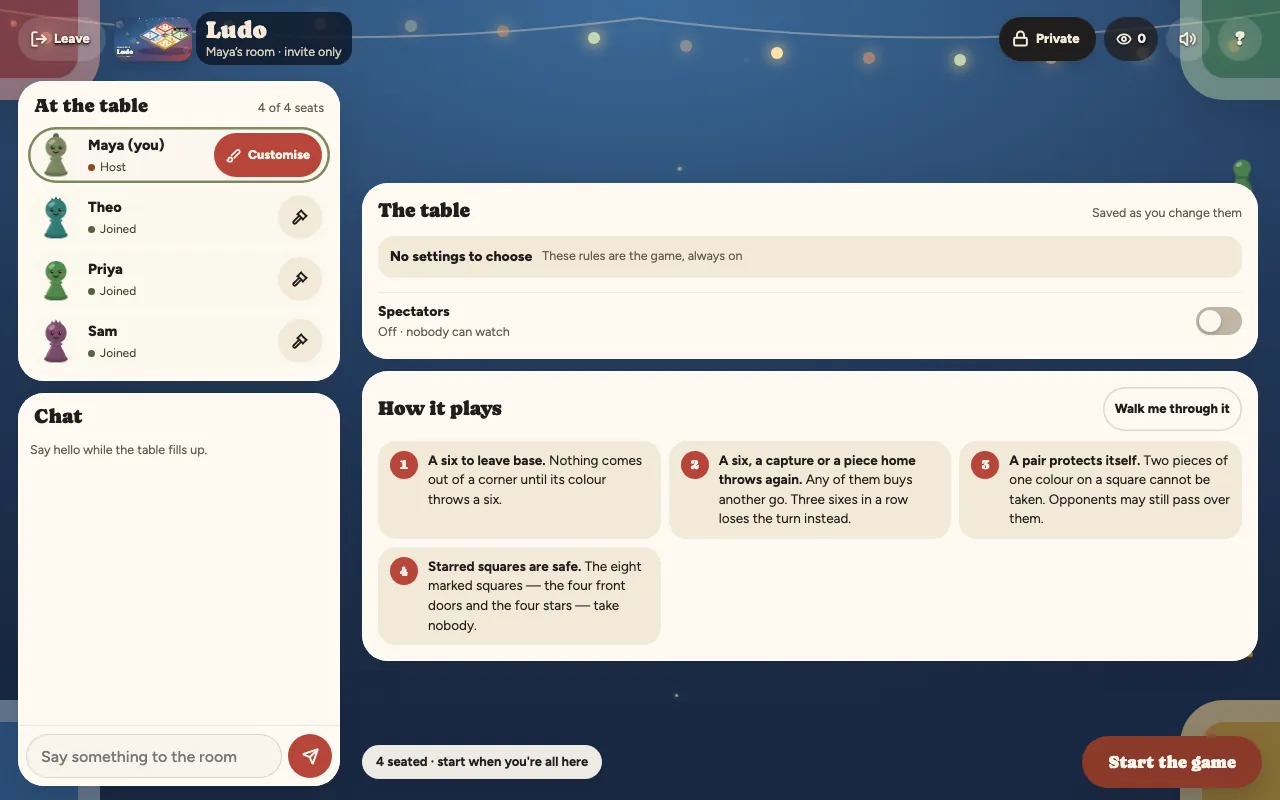
Every player starts with four pieces in their own corner, called the base, and nothing on the board. Turn order runs clockwise. There is no setup to negotiate and nothing to choose before the first throw, which is part of why the game travels so well: a table can start playing within seconds of sitting down. Boardit seats two to four, and a game usually runs thirty to sixty minutes depending on how often people send each other home.
Taking a turn
You throw one die and move one piece by that many squares. The catch that defines the whole game is that a piece cannot leave base without a six, and a six comes up once in six throws on average, so an unlucky opening can leave you watching for several turns. A six also earns another throw, as does landing on an opponent and sending them back to their base, or bringing a piece home — but three sixes in a row loses the turn entirely, which stops one hot streak running away with the game. Two of your own pieces sharing a square form a block that cannot be captured, though opponents may still pass over it, and the eight marked squares — four front doors and four stars — are safe ground where nobody can be taken.
How it ends
Getting home requires an exact throw. If your piece needs three squares and you roll a five, that piece simply cannot move, and you will often spend the last few turns of a game waiting for one specific number while somebody behind you catches up. The first player to bring all four pieces into the centre wins, and the rest keep playing for second and third rather than the table breaking up — which matters more than it sounds, because a four-player game where two people are finished is a game two people have stopped enjoying.
How to win at Ludo
Ludo rewards patience with a die that does not care about it, but there are real decisions inside the luck. The first is pairs against spread. Two of your own pieces on one square form a block that cannot be captured, and that is the only protection you can build yourself, so a six spent bringing a piece alongside another is often worth more than a six spent freeing a fourth piece onto an exposed square. The second is the eight safe squares — the four coloured front doors at the start of each arm, and the four stars, each 8 squares past a front door. Learn where they are and time your moves to land on them when an opponent is close behind. The third is the capture, which is a trade rather than a gift: it costs an opponent a full lap and hands you another throw, but the piece that takes it usually leaves a pair or a safe square and ends up alone where the whole table can see it. Against one opponent it is usually worth taking; at a full table it often is not. Late on, the exact throw home is what loses games. A piece sitting two squares short of the centre needs a two and nothing else, so bring pieces into the home column one at a time rather than parking them all on the doorstep.
What the host can change
Nothing about the rules, by design. Ludo here has no rule settings: every table plays the same game, so a player who learns it at one table knows it at every other. Each turn has 30 seconds — a fixed clock, not a table setting — and running out does not skip you: the table throws on your behalf and plays an obvious move, so one person taking a phone call cannot stall a board of four. What the lobby does decide is who sits where: seats and colours are picked before the first throw, and the room stays open for ten idle minutes so a friend who is slow to arrive still finds it there.
Why Boardit plays it this way
Every table plays the same Ludo, because almost every argument about Ludo is about house rules; with one rulebook, nobody has to settle anything before the first throw. Three sixes in a row lose the turn, so one hot streak cannot carry a single player round most of the board. Two of your own pieces on a square shelter each other but do not block the track, which keeps the game moving instead of jamming behind a wall. And the 30-second clock plays an obvious move rather than skipping the turn, because a skipped player could never throw the six they need, and one person taking a phone call should not freeze a board of four.
Playing Ludo online
Ludo online with friends is the version most people actually get to play, because getting four adults around one physical board is harder than getting four adults onto one web page. It is a browser game with nothing to install: open a board, send the five-character code, and two to four people join from wherever they are, on a phone, tablet or laptop. If you would rather not wait for friends, Quick match seats you at an open table or opens one for others to find. Either way a room is a lobby first: the game begins when the host starts it. Guests are asked for a name and nothing else — no account, no email, no app store. Multiplayer here means everyone sees the same board update at once, so a capture lands in front of the person it happened to rather than being reported to them afterwards. Ludo also happens to survive a bad connection better than most games, because a turn is usually one throw and one move; if somebody drops for twenty seconds the table waits, and the turn clock plays an obvious move for anyone who stays away too long.
Common questions
- Can two pieces share a square in Ludo?
- Yes, in two cases. Two of your own pieces on one square form a pair that cannot be captured, though opponents may still pass over it. And on the eight safe squares, pieces of any colour can sit together and nobody is taken. Anywhere else, landing exactly on a lone opponent sends that piece back to its base and earns you another throw.
- What happens if a player stops moving in Ludo?
- Their turn is played for them. Each turn has 30 seconds, and when it runs out the table throws and moves on that player's behalf: a capture if there is one, otherwise a piece home, otherwise a piece out on a six, otherwise the piece furthest along. So an absent player still threatens your pieces, and one person taking a call never stalls the board.
- How many people can play Ludo online together?
- Two to four, one for each colour on the board. Four is the game at its best, because every colour is in play and captures happen constantly; two is quicker but thinner, with half the board empty and far fewer pieces to run into.
- Do you need a six to start in Ludo?
- Yes — a piece cannot leave its base until that colour throws a six, and a six comes up once in six throws on average, so the first piece can take several turns to appear. The six that brings it out also earns another throw. It is the rule new players most often get wrong, and the reason an opening can feel slow.
- What happens if you roll three sixes in a row?
- Your turn ends at once: the third six is thrown away and nothing moves. Without the rule a lucky run could carry one player around most of the board in a single turn, which is not a game so much as a spectator sport for everyone else.
- Which squares are safe in Ludo?
- Eight of the 52 squares on the track: each colour's front door, where its pieces come out, and a star 8 squares past each front door. Nobody can be captured on them, and two pieces of one colour sharing any square protect each other too. Everywhere else, an opponent landing exactly on you sends that piece back to base, which is why finishing a move on a star is often worth more than moving further.
- Do you have to roll the exact number to finish in Ludo?
- Yes — the centre must be reached exactly. Overshoot and that piece cannot move; you use the throw on another piece if you have one, or lose the move if you do not. A piece that does reach the centre earns another throw, the same reward as a six or a capture.
- Can I play Ludo against the computer?
- No — every seat is a real person; there are no computer opponents. Two players is the smallest table, so you need at least one other person: a friend with the room code, or a stranger at an open table through Quick match.
- How long does a game of Ludo last?
- Usually 30–60 minutes, depending almost entirely on how often people send each other home. A game where nobody captures anybody finishes fast; one where a piece gets sent back on the home straight can run much longer. Every turn is on a fixed 30-second clock, so the length comes from the dice rather than from anyone deliberating.
- Where does Ludo come from?
- From pachisi, played in India for centuries and known there long before it reached anywhere else. The version most of the world plays now was simplified and patented in England in the 1890s under the name Ludo, which is simply Latin for "I play". The same game travelled under other names across South Asia, the Middle East, Africa and Europe, which is why almost everybody recognises the board and almost nobody agrees on what to call it.