Trivia Tavern Online Trivia Game
Trivia Tavern is Boardit’s online trivia game for 2–8 friends. Everyone answers the same multiple-choice trivia questions on their own phone, and the fastest right answer scores most. Free, no download.
Free, in the browser. You get a short code to send your friends; guests play without an account. Nobody around? Play on your own and beat your best.
Open Trivia Tavern tables
Looking…Sit me at the fullest table.
We look for a Trivia Tavern table that is nearly full and still open. Nothing open? Play on your own, or open your own table.
How Trivia Tavern plays
Choose the categories before you start
The host chooses the subjects, or leaves it on Mixed so every category comes up equally.
Four answers, one is right
Every question is multiple choice. There is no help, and you cannot skip.
The fastest right answer scores the most
Everyone answers every question, and every right answer scores points. The first right answer scores the most. The host can choose a slower mode where a quick answer gives only a few more points.
Each round gets harder, and the last one counts double
A round starts with easy questions and ends with a question whose answer is a number, such as a year. The nearest number wins. The last round gives double points, so anyone can still win.
The highest score at the end wins
Scores add up across every round, and everyone can see the scores the whole time.
Play Trivia Tavern online with friends
How to play Trivia Tavern online with friends
- Open a table. Press Create a room on this page; you do not need an account to host or to join.
- Send the five-character code. Each friend opens Boardit, chooses Join with a code and types it, on their own phone. Two players on different phones make it a head-to-head quiz.
- Fill the seats: two to eight players. Every seat is a real person, because there are no computer opponents in Trivia Tavern.
- The host picks the categories, the number of rounds and how scoring works, then presses Start. Pick nothing and the whole catalogue comes in.
- A question appears with four answers and a clock, and everybody answers at once on their own screen. Right answers score, quicker ones score more, and the highest total after the last round wins.
Trivia Tavern is a live quiz for two to eight players, run from one room code with everybody answering on their own phone. The bank holds over two and a half thousand authored questions in nine categories — general knowledge, movies and TV, music, sport, geography, history, science, food and drink, and video games — all about things most people have heard of, and the host picks which categories come up before the first question. It exists because most quiz nights fail the same way: one person knows everything about one subject and is bored for the rest of the evening. Choosing the categories in advance, and keeping the questions famous rather than obscure, is what stops that.
Setting up
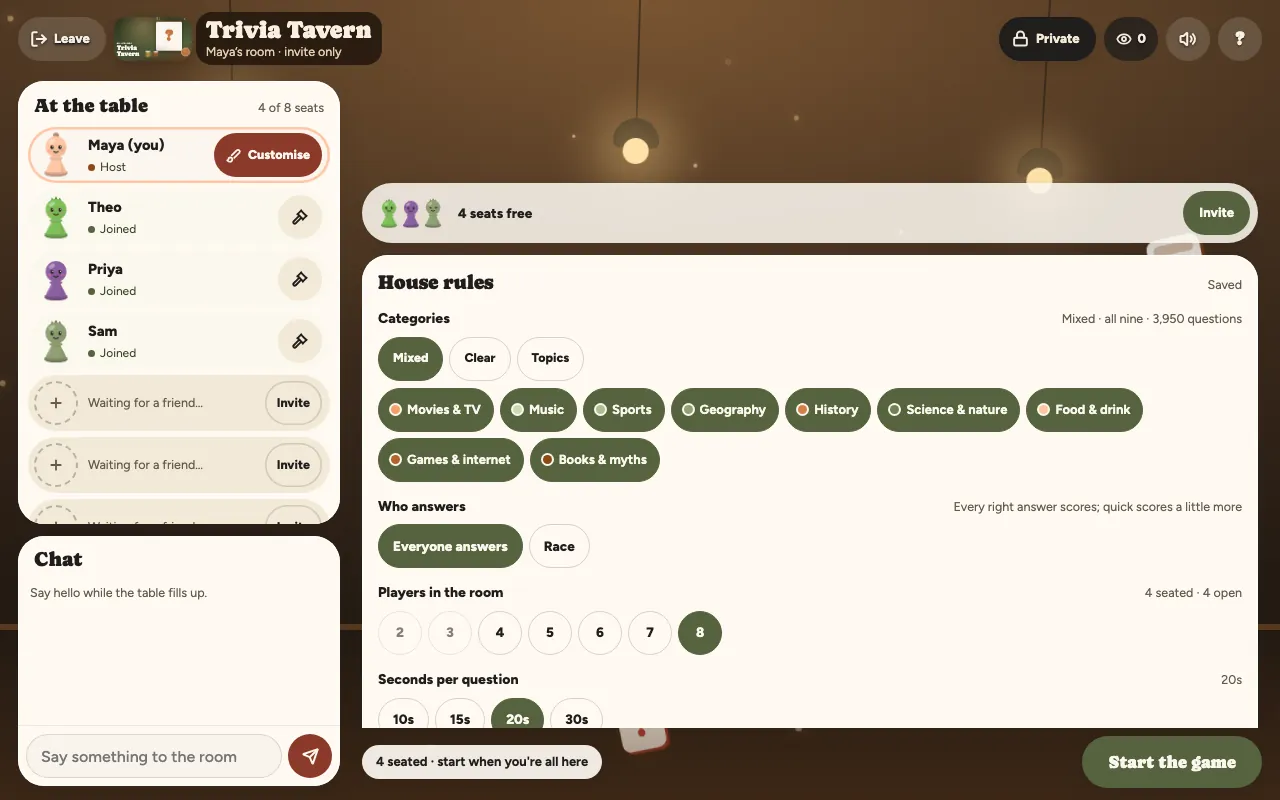
The host opens a room and chooses the categories, the number of rounds and how scoring works. Everybody else joins with the five-character code, on whatever device they have. Two to eight players, and about 10–15 minutes for the default three rounds. If the host picks nothing the whole catalogue comes in, which is the fastest way to start and the fairest round to open with, because nobody can prepare for it.
Taking a turn
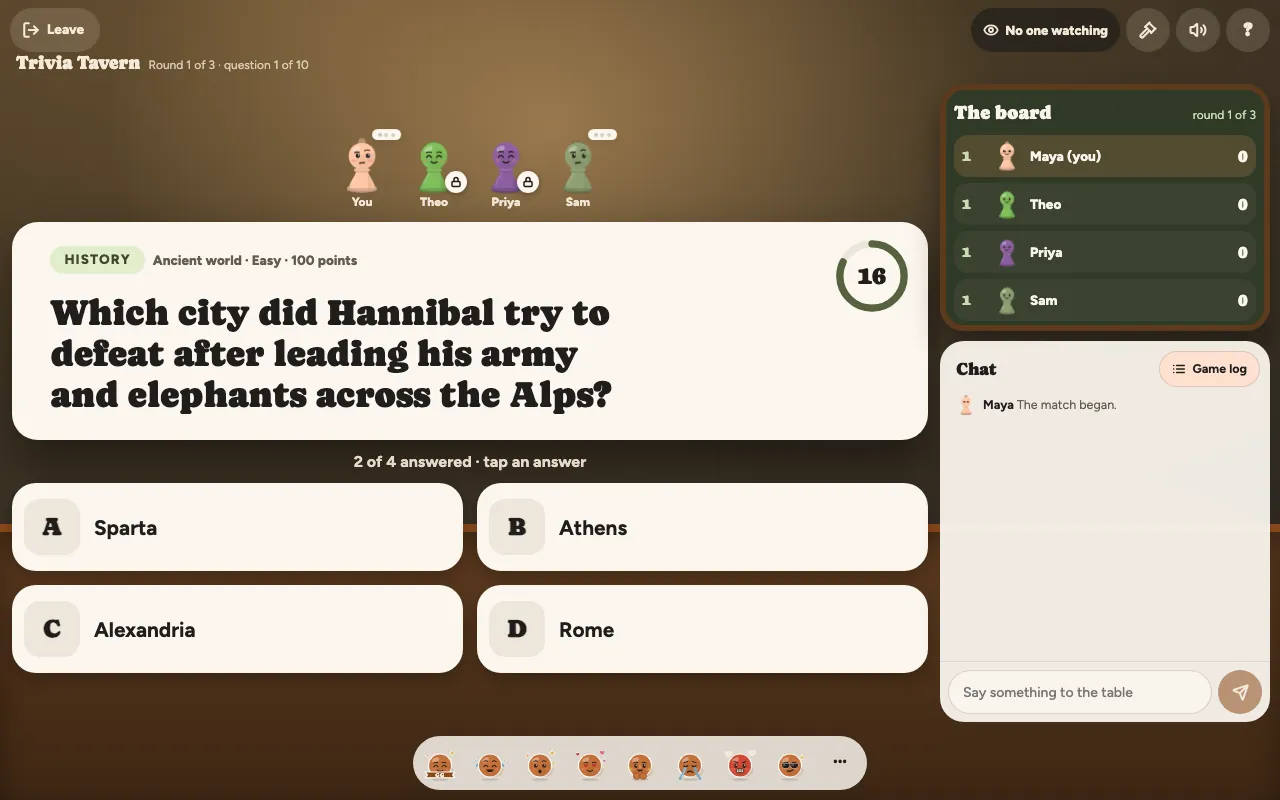
A question appears with four answers and a clock. Everybody answers at once on their own screen, so there is no buzzing in and nobody waits their turn. There are no lifelines and no passing — you answer or you do not. Every right answer scores and a wrong one scores nothing; how the host set the table decides how much a right one is worth. An easy question carries 100 points, a medium one 200 and a hard one 300. By default it is a race: right answers are paid in the order they arrive, full points for the first, then a shrinking share for each one after, with everybody who gets it right still scoring something. In the gentler setting a right answer gives up to a quarter of its points back for using the whole clock, so a quick answer earns a little more and a slow one still keeps at least three quarters. That changes the game: the race rewards knowing instantly, and the gentler setting rewards knowing at all. With two or more at the table, the last question of every round asks for a number instead, like a year or a height, and the closest guess wins it.
How it ends
Scores carry across every round and the standings stay visible throughout, so nobody discovers they were losing only at the end. Highest total after the final round wins, and by default that final round counts double, so a player trailing after the opening rounds is still in it at the end; the host can switch the double off, and a one-round match has nothing to double. If two players finish level, sudden death settles it, and its 5 spare questions are drawn when the match starts, so a tie cannot run into an empty pool. Running several rounds rather than a single sudden finish is deliberate — one unlucky question about a subject nobody at the table follows should not decide an evening.
How to win at Trivia Tavern
Most of the winning happens in the lobby, before a question is asked. Category choice is the setting people skip and the one that decides the night: a table that shares no interests should take the whole catalogue, because nobody can prepare for it and every round stays live, while a table that all follow the same football will have a far better time narrowing down. Scoring mode is the other lever. The race, the default, pays right answers in the order they arrive, which makes a sharper, noisier game and rewards knowing instantly; the gentler setting, where every right answer keeps most of its points, keeps slower players in it to the last round. Pick the gentler one if the table is mixed and you want it to stay close. In play, know what the clock is actually worth. A wrong answer scores nothing. In the race the fourth right answer onwards is paid half, so speed matters on the subjects you know, but a right answer late still beats a wrong one fast. On the gentler setting a right answer keeps at least three quarters of its points even as the clock runs out — so a question you are unsure of is worth the extra seconds it takes to get right. And read the standings between rounds: they stay visible for a reason, the final round counts double by default, and knowing you are a few hundred points back changes whether you should be guessing.
What the host can change
The host controls the categories, the number of rounds and how many questions each holds, the clock, the difficulty, the scoring mode, the double-points final round, the wager final and the sudden-death tiebreak. Category choice is the setting that matters most and the one people skip: a table of friends who share no interests should take the whole catalogue, while a table that all watch the same football will have a much better night narrowing it down.
Why Boardit plays it this way
Everyone answers the same question at once on their own phone, because a buzzer round turns a quiz into a reflex test and leaves the slower readers watching. The race, where the first right answer scores most, is the default because it keeps every question tense, but everybody who gets it right still scores; the gentler setting, where a right answer keeps at least three quarters of its points however long it takes, is there for a mixed table. The host picks the categories because the usual way a quiz night fails is one person who knows everything about one subject. And the bank has no song lyrics at all: a lyric question cannot be written without printing the lyric, so the music questions ask about songs and never quote them.
Playing Trivia Tavern online
An online trivia game with friends works differently from a quiz night with a host reading questions aloud, and mostly better. Everybody answers at once on their own phone, so there is no buzzing in, no waiting your turn, and no quizmaster who has to sit out to run it. It is a browser game with no download and no account for guests — two to eight players join a table with a five-character code, whether they are on the same sofa or three time zones apart. Two players on different phones make it a head-to-head quiz. Multiplayer scoring is what makes it a game rather than a worksheet: everybody who gets a question right scores, the fastest right answer scores most, and the standings stay visible so nobody discovers they were losing only at the end. The questions are already written, which is the real reason online quiz nights actually happen and offline ones often do not. From 13 September to 30 October 2026, Boardit's table log counts 201 finished Trivia Tavern games with at least two real people, and the middle one took 10 minutes.
Hosting a trivia night online
A trivia night here needs no quizmaster, because the questions are already written. The host opens a room, chooses the categories, the number of rounds and how scoring works, and everybody joins with the five-character code on their own phone, in the same room or over a video call. The default is three rounds, about 10–15 minutes in all.
Three choices shape the night. Leave the categories alone for a table with no shared interests, and narrow them for a table that follows the same sport. Use the gentler scoring for a mixed table and the race for a quick, noisy one. And keep the double-points final on, so the last round can still change the winner.
Trivia game for 2 players online
With two players you get the same questions, clock and scoring as a full table, with one other name on the scoreboard. It suits a couple or two friends on a call, each on their own phone. The last question of every round still asks for a number, like a year or a height, and the closest guess wins it. If you finish level, a sudden-death question settles it.
How the Trivia questions are built
The first bank, in September, asked about things you had to be a quiz fan to know. Players got its easy questions right only about half the time, and they stopped playing. So I threw it away and wrote over two and a half thousand new questions in nine categories on one rule: famous things, asked simply, so that most people get most of them right.
Every question has to pass four tests before it goes in. It has to be famous worldwide: I picture a twenty-year-old, a fifty-five-year-old and someone from another country, none of them into the subject, and if any of them would say “who?” about the question or about any of its four answers, it is rewritten or thrown away. It has to have one right answer and three wrong ones that are real and certainly wrong, never invented names, with nothing in the question that gives the answer away. It has to fit a phone, with a question of at most 110 characters and answers of at most 30. And it has to be labelled by who gets it right, not by how hard it sounds.
Easy, medium and hard are decided by how a mixed room should do: about nine in ten right on an easy question, about seven in ten on a medium one and four or five in ten on a hard one. Each category holds as many medium questions as easy ones and about a fifth hard, and a checking script refuses to load a bank where a category drifts from that mix. Hard is never obscure: when the answer is revealed, the table should say “oh yeah”, not shrug. Song lyrics, famous quotes and facts that expire, such as a “current” champion, are left out altogether.
Every question carries a one-sentence fun fact shown after the reveal and the sources that support the answer and the fact. After launch, once a question has been answered forty times, a second script moves its label to what players actually scored, and a question that fewer than three in ten get right is fixed or deleted. The bank is not finished; it is checked against real tables.
Common questions
- How can we play a trivia quiz online, each on our own phone?
- Open Trivia Tavern on Boardit and send the five-character code: everyone gets the same trivia questions on their own phone, each with four answers and a clock, and every right answer scores. It is free, runs in the browser and needs no download, so a group on a video call can start a quiz night in a minute, for an office party, a holiday call or National Trivia Day on 4 January.
- What topics does Trivia Tavern cover?
- Nine categories: general knowledge, movies and TV, music, sport, geography, history, science and nature, food and drink, and video games. The questions stick to famous things — blockbuster films, global hits, World Cups, capitals, school science — so a mixed table gets most of them right. The host picks which categories come up before the first question, or leaves them all in, which is the fairest round for a table that shares no interests.
- Does everyone answer at the same time?
- Yes. Every player answers the same question on their own phone at once, so there is no buzzing in and nobody waits their turn. There are no lifelines and no passing: you answer before the clock runs out, or you do not.
- How many players can play Trivia Tavern?
- Two to eight. With two it becomes a straight head-to-head: the same question, the same clock and the same scoring as a full table, with only one other name on the scoreboard. It suits a couple or two friends on a call, each on their own phone.
- How does the scoring work?
- Every right answer scores and a wrong one scores nothing. An easy question is worth 100, a medium one 200 and a hard one 300. By default it is a race: right answers are paid in the order they arrive, from full points for the first down to half. In the gentler setting a right answer keeps at least three quarters of its points however long it takes, and a quicker one keeps more. Each round ends on a closest-number question, where the nearest guess wins, and the last round counts double unless the host switches that off.
- How many questions are there?
- Over two and a half thousand, across nine categories. A default game of 3 rounds asks 30, so a group would have to play a great many evenings before repeats became noticeable.
- Can you choose the subjects?
- Yes — the host picks them in the lobby before the game starts. Leaving it open takes the whole catalogue, which is the fairest option for a table that does not share interests.
- How long do you get to answer each question?
- 20 seconds by default, and the host can raise or lower it in the lobby before the game starts. The clock is the thing that makes it a game rather than a pub quiz — you commit to an answer while you are still fairly sure rather than talking yourself out of it.
- Can you set how hard the questions are?
- Yes — the host picks easy, medium, hard, or Mixed, which is the default. Mixed is usually the right answer for a mixed table: every round starts with questions nearly everyone knows and builds to a couple of hard ones, so nobody sits out a round and the last questions still separate the table.
- Can I host a trivia night online?
- Yes. Create a room, send the five-character code and everyone joins on their own phone, in the same room or across a video call, with no download and no account. You choose the categories, the number of rounds and the clock in the lobby, so a casual online quiz night takes about a minute to set up, whether it is for two people or a table of eight.
If you like Trivia Tavern
Also free on Boardit, with no download: Ludo online, Snakes and Ladders online and a drawing game online. See all six online board games and party games on the home page, or read about the person who makes them.