Who's the Spy
Everyone gets the same secret word except the spy. Clues go round until the table votes out who doesn't know it.
See open tablesFree, in the browser. You get a short code to send your friends; guests play without an account. Every seat is a real person — there are no computer opponents.
Open Who's the Spy tables
Looking…Sit me at the fullest table.
We look for a Who's the Spy table that is nearly full and still open. Nothing open? We start one for you.
How Who's the Spy plays
Everyone gets a word, except the spy
The rest of the table shares one secret word. The spy is told the category and nothing more, and the host can deal more than one spy.
Clues go round, lap after lap
Describe your word without saying it — typed on your own screen, or out loud around one phone. Online, anyone can call a vote after every 2 laps. Too obvious and you help the spy; too vague and you look like one.
Then everybody votes
The table accuses whoever sounded least convincing, and a tie goes to a runoff. The vote ends the round, and everyone is dealt back in for the next.
Points every round
Everyone who votes for a spy scores a point, and so does every spy who escapes the vote. A lone spy then gets one guess at the word for another. Most points after the last round wins.
One phone or many
Play with everyone on their own device, or pass a single phone around the table.
Play Who's the Spy online with friends
Who's the Spy is a social deduction game for three to eight players, and the best game here for a room of people who already know each other. Everybody is given the same secret word except the spy — one player, unless the host deals more — who knows their role and the category but receives no word. Then you take turns describing your word without saying it, and try to work out who is describing a word they do not have. The spy knows they are bluffing from the start; civilians must give enough information to recognize each other without revealing the answer.
Setting up
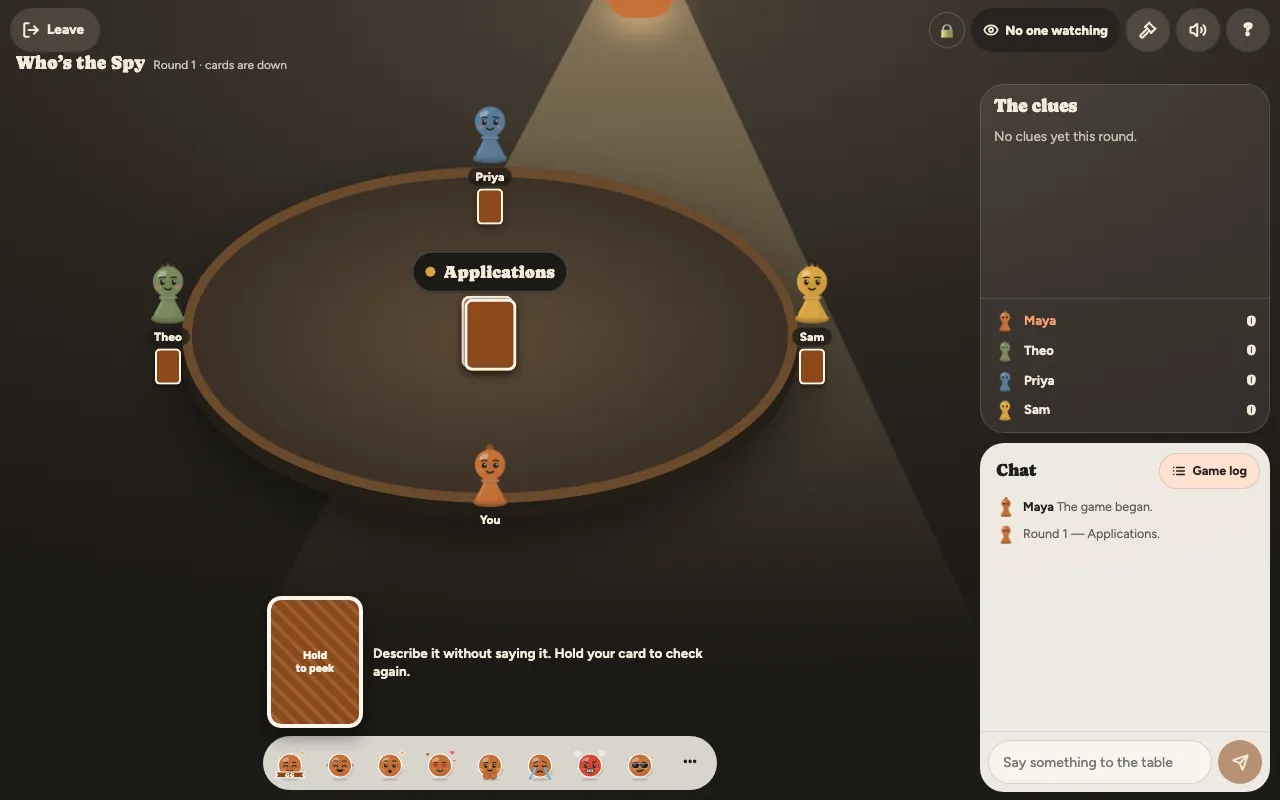
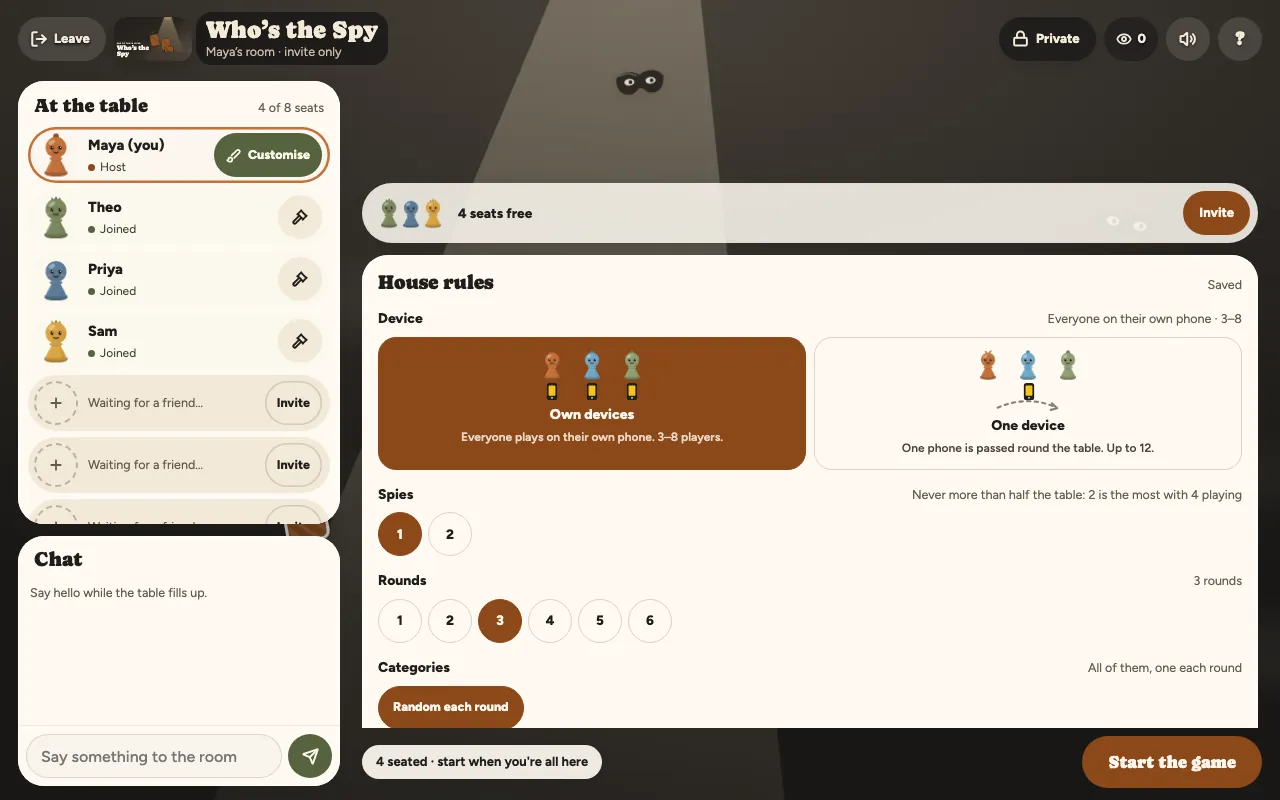
The host opens a room for three to eight players, or Quick match seats you at an open table. Words are dealt automatically at the start of each round, so nobody has to be trusted to look away. A game runs about 20 minutes across the default three rounds. There is a single-device mode if you are all in the same room and would rather pass one phone around than everybody stare at their own — which for this game is often the better experience, because in that mode clues are said out loud and everyone can watch each other's faces.
Taking a turn
On separate screens, clues go round the table in seat order: each player types a clue about their word, up to 20 characters, with 25 seconds to write it, and the table keeps going round. After every two laps there is a 10-second window in which anyone can call a vote, and the vote starts if a majority of the table does. So everybody gets at least two turns, and after six laps the vote happens whether anyone calls it or not. With one phone there is no clock at all: clues are said out loud, and whoever is holding the phone moves the table to the vote when it has heard enough. The skill is entirely in calibration: a clue too obvious hands the real word to the spy, and a clue too vague makes you sound like the spy yourself. Everybody hears everything, so a clue that was safe when the first player gave it may be dangerous by the time it reaches the fifth. Then everyone names whoever sounded least convincing; a tie goes to a runoff between the tied players, and the most-voted player is out.
How it ends
A round pays points rather than naming a winner. Everybody who votes for a spy scores a point, every spy who is not the player voted out scores a point, and a lone spy then gets one guess at the word from a short list, worth another point even after being caught. The highest total after the last round wins the game. That is what makes a bad round interesting: a spy who has guessed the word early is playing a completely different game from one who is still trying to blend in, and the table usually cannot tell which they are facing.
How to win at Who's the Spy
Both sides of this game are won by saying the least that still counts. As a civilian, the trap is describing the word so well that the spy simply learns it — say something only somebody holding your word would think of, but not something that hands it over. Clue turns follow seat order in online play: adapt your clue to the information available when your turn arrives. As the spy, your advantage is that everybody else is trying not to be too specific, so vagueness is normal and you are hiding in a crowd of it. Listen for the category before you speak, echo the shape of what came before without adding anything checkable, and if you are pressed, agree with somebody confident rather than inventing. The most common way to lose as a civilian is to be so cautious that you look like the spy — a clue nobody can connect to anything reads exactly like somebody who does not know the word. Say something real, just not the whole thing.
What the host can change
The host sets four things in the lobby before the first round. Devices: everyone on their own screen, or one phone passed round the table for up to twelve players. Spies: one by default, and never more than half the table, so the spies cannot simply out-vote everybody else. Rounds: one to six, three by default. Categories: any mix of the nine, or all of them with one drawn at random each round. There is no round clock to set, because a round ends when the table calls a vote. The single-device option is the one worth knowing about: it turns the game into something you play around a table rather than through a screen, and it is the only game here designed to work that way.
Why Boardit plays it this way
The spy is told the category but gets no word, so a civilian has to prove they hold the word, not just that they know the topic. Online, clues are typed, up to 20 characters, so the evidence is what somebody wrote rather than how nervous they looked on a webcam. The table calls the vote when it has heard enough, instead of a clock calling it. And nobody is knocked out of a game: every round deals fresh cards, points are scored every round, and even a caught spy gets one guess at the word, which keeps everybody careful to the end.
Playing Who's the Spy online
Who's the Spy online solves the one problem the physical version of this genre never quite does: dealing secret information without trusting anybody to look away. Each player's word arrives on their own screen, so there is no deck, no printing and no moderator sitting out to run the round. It is a browser game with no download and no account for guests — three to eight players join with a five-character code. Online, each clue is typed, 20 characters at most, so the game needs no voice of its own: the arguing happens around it, over a video call, in the same room with everyone on their own phone, or in a group chat. A clue is a few characters on a short clock, so a poor connection matters less than a quiet table.
Common questions
- How long can a clue be online?
- Up to 20 characters, typed, with 25 seconds to write it. Clues go round the table in seat order and everybody reads the same words, so the evidence is what was written rather than how somebody sounded. With one phone there is no limit: clues are said out loud.
- What happens if the vote is tied?
- The tied players go to a runoff, and only they can be voted for. The table votes again between them, and the player named most is out. A tie never ends a round on its own, so the table always has to commit to somebody.
- How many players do you need for Who's the Spy?
- Three at minimum, up to eight on their own screens or twelve passing one phone. Three is playable but tight — with only two non-spies a single wrong vote is fatal. Five or six is where the game is best: enough people that the spy can hide in the crowd, few enough that everybody gets to speak and be suspected at least once.
- Is this the same as the imposter game, the undercover word game or the spy game?
- Yes, it is the same family of hidden-role word game, though the rules differ from table to table. In Boardit, civilians receive the shared word and spies know their role without receiving any word; players give clues and vote. Some people call it a secret word game or a word imposter game, and it plays online the same way: each person on their own phone, no download. If you know the undercover version where the odd one out holds a second, different word, that is a variant this game does not play.
- Does the spy know they are the spy?
- Yes. The spy receives a card identifying their role and the public category, without the civilian word. The challenge is to infer the word while giving convincing clues. Boardit does not give the spy a different word.
- How does the clue round end in Who's the Spy?
- With a vote, called by the table rather than a clock. Online, every two laps of clues the table gets 10 seconds to call one, and a majority starts it; after six laps it starts regardless. With one phone there is no clock at all, and whoever is holding it moves the table to the vote. A tie goes to a runoff between the tied players.
- What happens if the spy works out the word?
- It is worth a point. Once the vote is over, a lone spy gets one guess at the word from a short list, even if the table caught them, which is why civilians have to be careful about how precise their clues are. A clue that proves you know the word to everybody else also tells the one person who does not. The best civilian clues are ones that only make sense if you are already holding the word.
- What kinds of words are used?
- Everyday ones, drawn from nine categories — places, food, applications, transport, animals, jobs, sports, household objects and clothing — and the table is told which category is in play. The host can narrow the match to any of them. Knowing the category is what makes the round work: it narrows the field enough for clues to mean something, while leaving the spy room to bluff inside it.
- Can you play in the same room on one phone?
- Yes — there is a single-device mode for up to twelve players where the phone is passed around and clues are said out loud, which for a group sitting together is usually better than everybody looking at their own screen.
- How many rounds does a game run?
- Three by default, and the host can pick anything from one to six. One round is a few minutes and a single vote, which is too small a sample to be satisfying on its own; playing several means the spy changes hands, everybody gets a turn at bluffing, and nobody's evening is decided by one unlucky first clue. A default game lands at about 20 minutes.