Snakes & Ladders
Roll the die and race to square 100. Ladders carry you up, snakes slide you back down.
See open tablesFree, in the browser. You get a short code to send your friends; guests play without an account. Every seat is a real person — there are no computer opponents.
Open Snakes & Ladders tables
Looking…Sit me at the fullest table.
We look for a Snakes & Ladders table that is nearly full and still open. Nothing open? We start one for you.
How Snakes & Ladders plays
One throw a turn
A six buys nothing extra — no second roll, no bonus move.
Ladders climb, snakes drop
Land on the foot of a ladder and you go up it. Land on a snake and you slide back down.
Square 100 has to be hit exactly
Roll more than you need and you stay where you are until the number comes up right.
30 seconds a turn
Run out and the table throws for you, so one distracted player cannot stall everyone.
Play Snakes and Ladders online free with friends
Play Snakes and Ladders online free with friends: two to eight players, each on their own phone or laptop. One person opens a room, shares a five-character code, and guests join without accounts or downloads. The game itself is the purest luck game most people ever play, and that is the point of it rather than a flaw. Historical Indian forms such as Gyan Chaupar used progress and setbacks on the board to teach lessons about conduct. A British version from 1900 still rewarded virtues such as kindness and obedience. The familiar race has no decisions: you throw, you move, and the board does whatever it was always going to do — which makes it a game where a six-year-old and an adult can be evenly matched.
Setting up
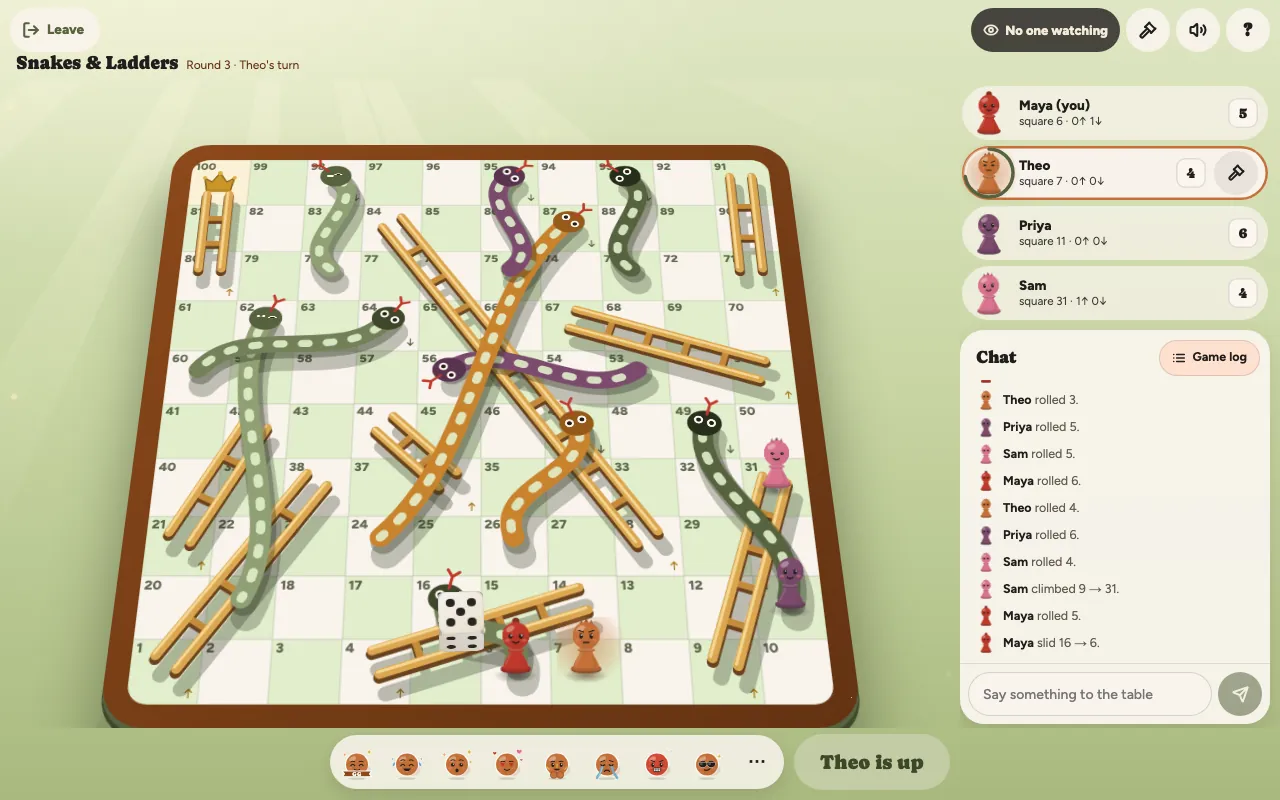
Every player starts off the board, and the first throw moves a counter straight onto the square it shows: a four lands on square four. The board runs to 100, numbered in a boustrophedon — left to right along the bottom row, right to left along the next, and so on up — which is why the numbers appear to zigzag. Ladders connect a lower square to a higher one and snakes do the reverse. Two to eight players; a game takes about a quarter of an hour, and it is over faster than anyone expects when the long ladders fall the right way.
Taking a turn
One throw, one move, and that is the whole turn. A six buys nothing here — no second roll, no bonus, no special entry — which is the rule most people carry in from other dice games and get wrong. If you finish your move on the foot of a ladder you climb it immediately. If you finish on a snake’s head you slide to its tail. You cannot choose to decline either, and the slide happens as part of the same turn, so a single throw can move you a very long way in either direction.
How it ends
The final square has to be hit exactly. Roll more than you need and you stay where you are and throw again next turn, which is why a game that looked finished can last another five minutes with somebody sitting two squares short waiting for a two. First to land exactly on 100 wins.
How to win at Snakes & Ladders
There is no strategy, and that is not a gap in this section — it is the game. A hundred squares, nine ladders, ten snakes, one die, and no choice at any point: you roll, you move, and the board does the rest. Nothing you know about the board changes what you should do, because there is nothing to do. It is worth saying plainly because people search for tactics here and every answer they find is invented. What the absence does is the interesting part. A game with no decisions cannot be played badly, which means a six-year-old and an adult can compete on level terms. The only real choices are the ones made before the first roll: how many players, and whether you have fifteen minutes. If you want a race with decisions in it, Ludo is the same shape of game with a board that argues back.
What the host can change
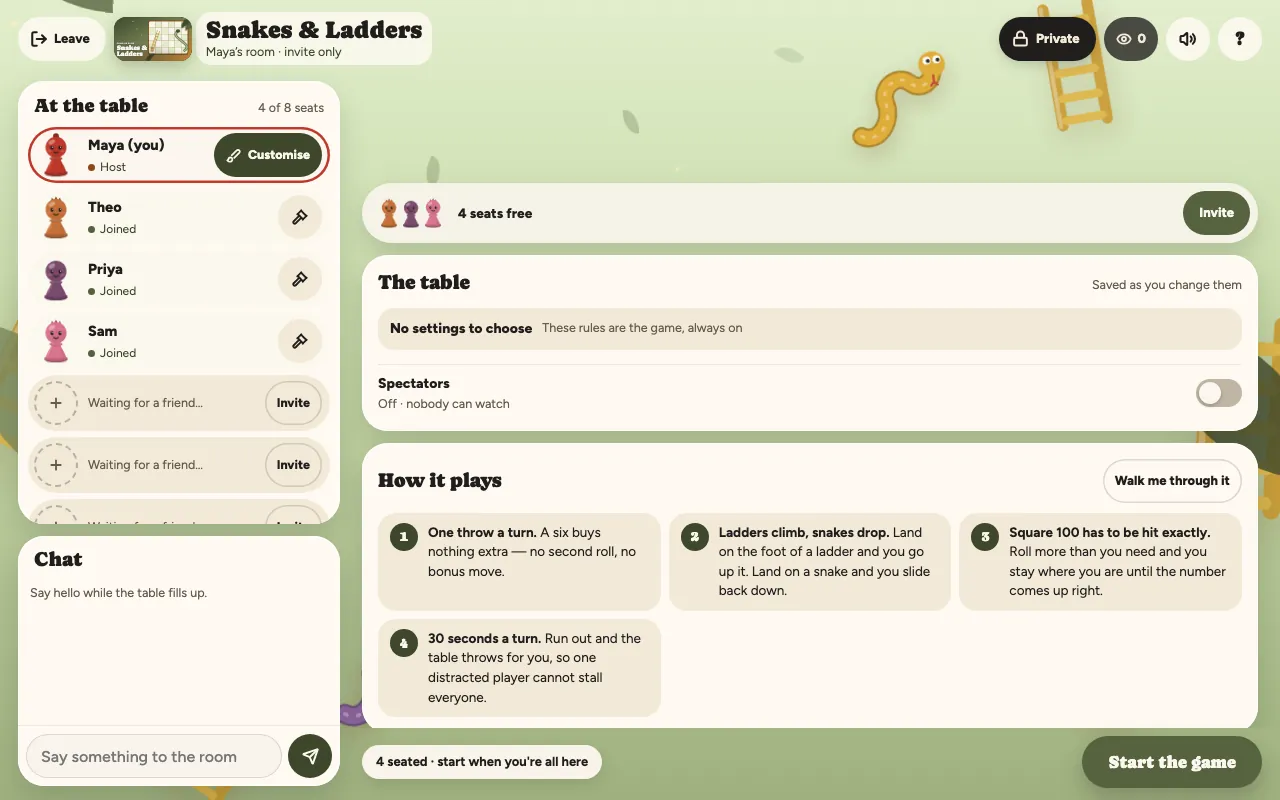
There are no rule settings: every table plays the same board by the same rules. Each turn is capped at 30 seconds. Run out and the table throws for you — there is no decision to miss, so an automatic throw costs you nothing, and it means one distracted player cannot hold up a board. The host opens the room, everybody joins with the code, and the lobby closes itself after ten idle minutes if the game never starts.
Why Boardit plays it this way
There are no settings because there is nothing to decide: the die picks the square and the board does the rest, and that is the whole point of the game. Counters start off the board, on a square 0, so the ladder on square 1 can actually be reached with a throw of one; starting on square 1 would have made it unreachable. The exact throw to finish stays, because the top row is the only tension this board has: a counter can sit a few squares from 100 while the snakes on the last row decide the game. And a table seats up to eight, because a game with no decisions is one of the few a whole family can play at once.
Playing Snakes & Ladders online
Snakes and Ladders online is the easiest game on this site to get a group into, because there is nothing to learn and nothing to install. It runs in a browser on any phone or laptop — no download, no account for guests — and joining is typing a five-character code. That matters more than it sounds for a game that is often played with children or with relatives in another country: the barrier is usually the setup, not the game. Multiplayer means two to four players moving on the same board in real time, so a ladder or a snake happens in front of everybody at once, which is the entire social content of this game. Fifteen minutes start to finish makes it a good opener while people are still arriving, or a good closer when nobody has the attention left for anything with rules.
Common questions
- Do you have to take a ladder or a snake?
- Yes, the moment you land on one. A ladder carries you up and a snake drops you down straight away, and there is no choice to decline either. That is the whole game: nobody decides anything, which is why a child and a grandparent are exactly even.
- What happens if a player wanders off mid-game?
- The game keeps going. Each turn has 30 seconds, and when a player's clock runs out the table throws the die for them, so the counter still moves and nobody waits on a phone left on the sofa.
- How many people can play Snakes and Ladders online?
- Two to eight, one counter each on the same board. A game takes about 10–25 minutes, which makes it the one to open an evening with while people are still arriving, or to close one with when nobody has the attention left to learn rules.
- Is it snakes and ladders or snake and ladder?
- Both, and neither is wrong. The plural is the usual British form and the singular — snake and ladder — is ordinary in Indian English, which is where the game came from in the first place. It is the same game either way: one die, ladders up, snakes down, no decisions anywhere in it.
- Do you need a six to start Snakes and Ladders?
- No — your first throw moves you onto the board whatever it shows, so a four puts you on square four. A six is not special later either: no second roll, no bonus move. The six-to-start rule belongs to Ludo and gets imported by mistake constantly, and the bonus roll is a household variant that makes games shorter and more one-sided.
- What happens if you roll too high near the end?
- Nothing moves. Square 100 must be reached exactly, so a player needing three who rolls a five stays put and waits for the number. It is the only tension the game has and it is worth keeping.
- Is there any skill in Snakes and Ladders?
- No — none whatsoever, and that is the appeal. There is no decision to make on any turn: the die picks the square and the board decides what happens there. That makes it the rare game a small child can win against an adult on completely level terms.
- How many squares are on a Snakes and Ladders board?
- There are 100, laid out in ten rows of ten, with the numbering running back and forth so square eleven sits directly above square ten. Boardit’s board has nine ladders and ten snakes across those squares. Historical boards varied; the British Museum catalogues one Gyan Chaupar board with 342 squares.
- Where did Snakes and Ladders come from?
- From historical Indian moral games such as Gyan Chaupar. Surviving boards varied in size, labels and religious framing, so there is no single layout to call the original. A V&A resource documents a British moral version from 1900; the sources reviewed do not establish one exact arrival year.
- Is Snakes and Ladders a good game for mixed ages?
- Yes, and that is its real strength: there are no decisions, so nobody can play it better than anybody else, and a grandparent, a parent and a teenager are genuinely equal rather than politely pretending to be. Boardit itself is a general-audience site and is not directed at children under 13, so a younger child should be playing alongside an adult who runs the device and the room.